
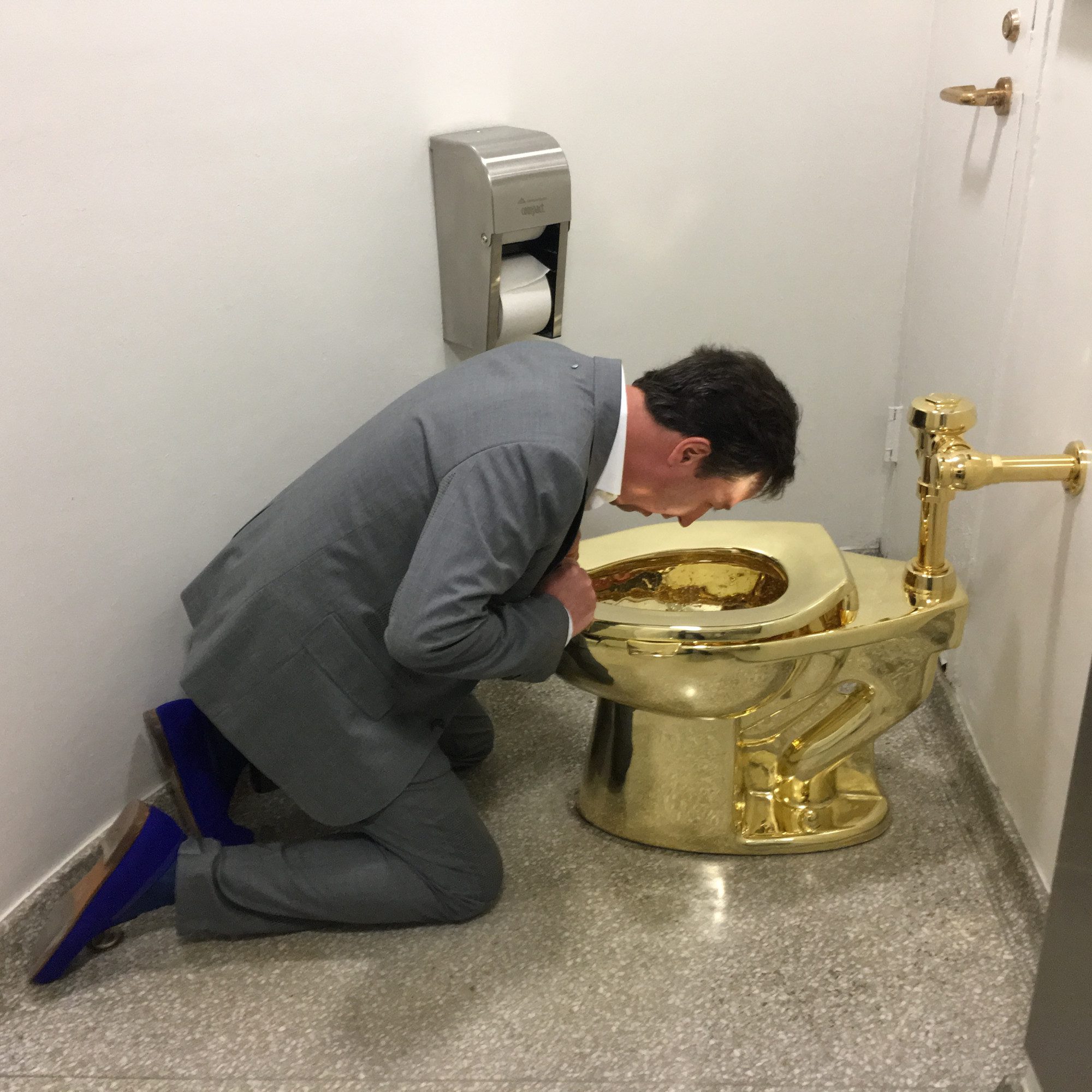
Nothing says “America” like an ostentatious golden throne.
And, I don’t mean the regal kind for kings in court. I mean the kind humanity sits on every morning after coffee, typically made of porcelain.
The existence of a golden toilet makes Idiocracy feel like a fast approaching reality.
The art piece.
A toilet (yes) was cast in solid 18-karat gold. Too heavy to lift for average plumber installation, valuable enough to buy a private island, and absurd to the point of cringe, awe, and confusion.
This pricey yet functional creation was intended as interactive art – and it definitely made a statement.
Italian conceptual artist Maurizio Cattelan named it America, a satirical jab at wealth, consumption, and excess.

It wasn’t cordoned off like the Mona Lisa or displayed behind glass. At the Guggenheim Museum in New York, where it was first installed in 2016, visitors were encouraged to use it. And they did. Hundreds queued up daily to experience the strange thrill of relieving themselves on six million dollars’ worth of solid gold.
The idea was simple but devastatingly effective. On the surface, it mocked luxury culture and political vanity. Beneath that, it opened questions about value itself. We’re left questioning whether gold carries equivalent value as toilet art meant to mock modern excess or plain ingots.
The toilet is a mirror to American culture, and sadly, a global joke about our obsession with opulence. Cattelan himself coyly suggested that yes, it was about Trump, but also about more than Trump. “That shouldn’t be the only layer,” he said.
The toilet became a sensation, proof that sometimes the silliest idea is also the sharpest critique. And like many great works of art, its life didn’t stop at the museum.
From Guggenheim to Blenheim.
In 2019, America left New York and traveled across the Atlantic to the United Kingdom. Its destination: Blenheim Palace, a sprawling baroque estate in Oxfordshire and the birthplace of Winston Churchill. The Blenheim Art Foundation had organized a major exhibition of Cattelan’s work called “Victory Is Not an Option.”
This wasn’t a sterile gallery environment. The golden toilet was installed in a functional bathroom once used by Churchill himself. Visitors booked three-minute time slots to use the piece, just as they had in New York. It was art you could touch, flush, and walk away from feeling bemused and slightly complicit.
The discomfort and irony was intentional. In a palace built to project power and grace, the absurdity of a golden toilet was certainly a curiosity. Here was wealth mocking wealth, history colliding with satire. It was a statement that fit both the artist’s sense of humor and the exhibition’s themes of power and fragility.
But Blenheim wasn’t New York. It was a palace open to the public, with security suited for tourists, not so much defending multimillion-dollar art.
The (messy) heist.
At around 4:50 a.m. on September 14, 2019, intruders broke into Blenheim Palace. Within five minutes, they had ripped America from its plumbing, yanking it free with sledgehammers and brute force. The theft wasn’t elegant. Pipes burst, flooding part of the palace as the thieves fled.

Witnesses later described the scene as almost slapstick. Security stared into Churchill’s old bathroom, awestruck by burst pipes soaking history in toilet water. In broad daylight, the palace confirmed the theft and shut down tours.
The headlines wrote themselves: “Thieves steal solid gold toilet.” “Palace flooded after golden loo stolen.” “Cattelan’s America vanishes in the night.”
For many, the heist itself felt like the final stroke of the artwork. A satire about greed had been literally stolen, turned into the very thing it mocked: an object of lust, stripped of meaning, worth only its melt value.
It was finally solved.
The case stretched for years, winding its way through courtrooms and forensic reports. The suspects were not organized geniuses seen in movie heists; they were ordinary criminals with histories of burglary and fraud.

James Sheen, a man with more than 30 prior convictions, emerged as the mastermind. He coordinated the theft, later sending coded text messages about selling “the car” for “26 and a half,” shorthand for £26,500 per kilo of gold. Michael Jones, another key player, had actually visited the exhibition beforehand, using the toilet and calling it “splendid.” Frederick Doe, also known as Frederick Sines, was tied to laundering the proceeds.
Investigators pieced the puzzle together with DNA from sledgehammers, CCTV footage, and even gold flecks found on clothing. By 2023, charges were brought. By 2025, convictions were secured. Sheen received a four-year sentence. Jones got two and a half years. Doe was given a suspended sentence with unpaid work. Another man, accused of being the getaway driver, was acquitted.
The investigation answered some questions, but not the one that mattered most.
The golden toilets fate.
Where is the golden toilet now?
That’s the mystery that haunts the case. Authorities believe it was quickly dismantled and melted down after the heist. Unlike a painting or sculpture, a golden toilet is both unique and impossible to hide. It could never resurface intact without global headlines. The most plausible explanation is the simplest: the art was destroyed, its gold sold off in pieces.
Experts in art crime call it the worst possible outcome. A one-of-a-kind conceptual work, transformed into anonymous gold bars. A satirical jab at greed, undone by actual greed.
I think the thing is more valuable as Valentine’s jewelry than an expensive privy, no matter how good the joke is.
Its absence has elevated the story. America has become more famous in disappearance than it ever was in display.
Cattelan didn’t even mind.
Cattelan didn’t relish in victimhood at the destruction of his art.
Known for works like a taxidermied horse suspended from a ceiling and a sculpture of the pope struck down by a meteorite, he thrives on irreverence.
When asked about the theft, he quipped that he’d always loved heist films and now he was starring in one. He treated the disappearance as an extension of the piece. The heist added to the narrative of the piece as it the vanishing made headlines and garnered global attention.
That’s “conceptual art” for you. Artists chase the impact of even temporary pieces, chasing wow factors and legacy.
The golden toilet is now relegated to a story and 18 karat ingots. It lives in headlines and rumors.
Thoughts and aftermath.
America, the exaggerated art toilet, is no longer with us. Personally, I’m good with that.
Of course, art enthusiasts (especially those that love concept art) have their opinions. As the average citizen, I’m relieved and a little amused that such a disgusting and expensive joke on our maximalism is no longer being celebrated. With the cost of the material itself exceeding $1 million, I still prefer the idea of that cash in circulation, even if it was stolen and spent by criminals.
Calling it “priceless art” seems like an exaggeration to me. If you want the ‘beautiful’, aesthetic appeal of a toilet, go look in your own restroom. Go to McDonald’s and you can witness the artistic shape 5 times in their bathrooms. It doesn’t take much imagination to visualize them in gold.
On the other hand, this was a legit robbery.
The irony is almost too much. An artwork meant to critique greed was undone by greed. The heist made the satire literal. And in doing so, it turned a single object into a story that will outlast gold prices, prison sentences, and even the memory of who exactly stole it.
The story is equal parts comedy, irony, and cultural commentary – all the product of the insanity of one artist and a few crooks.
Sources
- Wikipedia: America (Cattelan)
- AP News: Golden toilet stolen from Blenheim Palace trial
- AP News: Man convicted in golden toilet heist
- The Times (UK): Blenheim gold toilet thieves sentenced
- The Guardian: Blenheim Palace gold toilet heist sentencing
- The Times (UK): Maurizio Cattelan interview
- Public Delivery: Maurizio Cattelan’s America
- DailyArt Magazine: Maurizio Cattelan’s America
- Insurance Journal: Golden toilet still missing
Leave a Reply